



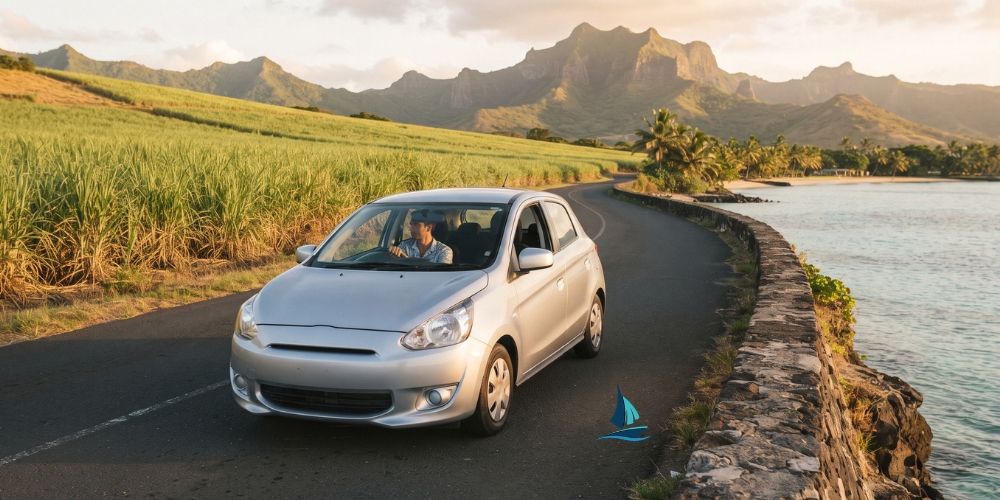
Buying a Car in Mauritius: Import It or Buy Locally?
Your left-hand-drive car from Europe cannot simply be registered in Mauritius. Here is what the rules, taxes and real costs mean for anyone relocating to the island.
For anyone moving to Mauritius, one of the first practical questions is whether to ship a car from abroad or buy one locally. In most cases, the answer is straightforward: a left-hand-drive vehicle cannot be registered for road use in Mauritius. The real decision is therefore between importing a right-hand-drive vehicle and purchasing a car that is already registered on the island.
The first hurdle: right-hand drive
Mauritius drives on the left, and imported vehicles must be right-hand drive (RHD). A car bought in continental Europe, where left-hand drive is the norm, is therefore not a practical option for private use in Mauritius.
The regulations allow only two narrow exceptions for second-hand vehicles: importation for motor racing or for display purposes. In either case, a left-hand-drive vehicle may be imported, but it cannot be sold locally and must be re-exported once the authorised period ends.
For a practical import, the most relevant markets are the United Kingdom, Japan, South Africa, Australia and other countries where vehicles are already right-hand drive. This should be the first filter before considering budget, brand or model.
Importing a car: the rules
The law is clear: no one other than an authorised dealer or an “individual importer” may import a second-hand vehicle into Mauritius. This is not merely a cost issue: for a private buyer outside the permitted categories, importing a used car is prohibited.
Who qualifies as an individual importer?
An “individual importer” is a person or entity listed in Part I of the Second Schedule who imports a second-hand vehicle for their genuine personal use. The category includes, among others, foreigners taking up employment in Mauritius, investors or professionals holding an Occupation Permit for at least three years, certain retirees under a residence permit, and owners of IRS property.
The vehicle must be imported for the importer’s personal use, consigned to them and registered in their name. It must also be purchased abroad, without any transfer of funds from Mauritius. Buying a car using funds already held in Mauritius does not qualify for individual-importer status.
For a used vehicle
An import permit must be obtained before shipment. It is valid for 12 months and should be applied for well in advance to avoid delays with shipping, customs clearance or registration.
The vehicle must also be accompanied by an inspection certificate dated no more than four months before shipment, unless an exemption applies to an individual importer. The documentation must, among other requirements, confirm that the vehicle has not been stolen, is in good working condition, retains its original chassis and does not have a bull bar.
The age restriction
A second-hand vehicle imported into Mauritius must be between 18 months and four years old, calculated from its first registration date at the time of shipment. Only an individual importer may benefit from an exception to this age limit for their personal vehicle.
The authorities also strengthened the framework governing importers and dealers in October 2026, through the Consumer Protection Amendment Regulations 2026, to ensure that vehicles placed on the market comply with the applicable requirements.
What an imported car really costs
The price displayed abroad is never the final price. The calculation must include the CIF value — cost, insurance and freight — followed by import charges, logistics, inspection, registration and insurance.
For imported passenger cars, there is no separate customs duty: excise duty is the main import levy, followed by VAT.
| Vehicle type | Applicable excise duty | VAT |
| Petrol, up to 550 cc | 0% | 15% |
| Petrol, 551–1,000 cc | 45% | 15% |
| Petrol, 1,001–1,600 cc | 55% | 15% |
| Petrol, 1,601–2,000 cc | 75% | 15% |
| Petrol, over 2,000 cc | 100% | 15% |
| Non-plug-in hybrid | 25%–75%, depending on engine capacity | 15% |
| Plug-in hybrid | 15%–55%, depending on engine capacity | 15% |
| Electric, up to 180 kW | 15% | 15% |
| Electric, over 180 kW | 25% | 15% |
Excise duty is calculated on the CIF value. VAT of 15% is then applied to the CIF value plus the excise duty. A vehicle with a high CIF value, or an engine capacity above 2,000 cc, can therefore attract a substantially higher tax bill.
Registration duty
Since 1 July 2025, registration duty payable on a vehicle’s first registration has increased by 30%. It is not, however, a percentage of the vehicle’s price: it is a fixed amount, determined mainly by engine capacity.
| Petrol engine capacity | Registration duty |
| Up to 1,000 cc | Rs 21,200 |
| 1,001–1,250 cc | Rs 42,300 |
| 1,251–1,500 cc | Rs 67,600 |
| 1,501–1,600 cc | Rs 84,500 |
| 1,601–1,750 cc | Rs 101,400 |
| 1,751–2,000 cc | Rs 152,100 |
| 2,001–2,500 cc | Rs 202,800 |
| Over 2,500 cc | Rs 253,500 |
These amounts already include the 30% increase; do not add a further 30%.
Petrol-electric hybrids pay 50% of the corresponding petrol-vehicle amount. Electric vehicles have their own schedule, ranging from Rs 10,600 up to 70 kW to Rs 126,800 above 180 kW.
Buying locally: simpler, but still requires care
Buying a used vehicle that is already registered in Mauritius avoids customs clearance, an import permit, arrival inspection and the age restriction. Since July 2025, registration duty has also been removed on the sale or transfer of a used vehicle already registered locally. Administrative fees still apply, including Rs 400 for registration.
The transfer process between private parties has also become more streamlined following the digitalisation of NLTA services. Ownership transfers can now be completed online through the NLTA e-Services portal using a MauPass account, reducing the need for in-person administrative visits.
An active local market
Platforms such as MyCar, LexpressCars, CarMoris and WeShare list a wide range of new and used vehicles. However, an attractive listing is no substitute for a thorough check of the service history, mileage, accident record, bodywork condition and validity of the documentation.
Registration and insurance
To register an imported vehicle, the NLTA requires an inspection at a Vehicle Examination Station, completion of the Particulars of Motor Vehicle form, registration of the deed of sale with the Registrar General, and submission of the file with customs documents and, where applicable, the import permit.
Car insurance is mandatory. Its cost depends on the driver’s profile, the level of cover, the vehicle’s value and its intended use, so it should be included in the initial budget.
Annual road tax: an often-overlooked cost
Beyond the purchase price, the Motor Vehicle Licence — the annual road tax — must be factored into the budget. The 50% discount previously available for hybrid and electric vehicles was removed in the 2025-26 Budget: electric vehicles no longer benefit from this reduction.
If you buy or take over a vehicle with a personalised registration plate, note that the 2026-27 Budget introduced an additional annual fee of between Rs 5,000 and Rs 25,000 when renewing the licence.
These recurring costs matter when comparing a petrol, hybrid or electric vehicle over time, not merely at the point of purchase.
Import or buy locally?
| Factor | RHD import | Local purchase |
| Model choice | Wider, particularly through Japan or the United Kingdom | Limited to vehicles available locally |
| Timeline | Longer: sourcing, shipping, customs clearance, inspection and registration | Faster |
| Tax cost | Excise duty, VAT, registration duty and logistics | No registration duty on a local transfer |
| Documentation risk | High if the file is incomplete | Seller and vehicle history must be carefully checked |
| Best suited to | A specific model, specification or eligible importer | A quick, straightforward move |
For most newcomers, buying locally is usually the simplest option. Importing makes sense when the desired vehicle is not available on the island, the buyer qualifies as an individual importer, and the fully landed cost remains competitive.
How Magellan can help
Magellan supports expatriates, investors and families relocating to Mauritius, including with residence permits, administrative procedures and company formation. Let’s discuss your project.
For an import project, the priority is to secure the importer’s status, documentation, landed-cost calculation and registration process before committing.
Before reserving a vehicle or paying a deposit, obtain a full estimate covering the CIF value, excise duty, VAT, registration duty, freight, insurance, inspection, registration and realistic timelines. It is this total cost — not the overseas advertised price — that should guide the decision.
Sources of this article:
- MRA – Rate of excise duty and taxes on motor vehicles
- Annex to Budget Speech 2025-2026
- Registration Duty (Amendment of Schedule) Regulations 2025
- Registration of Vehicle Information in Mauritius
- National Land Transport Authority — Registration
- National Land Transport Authority
- Consumer Protection (Control of Imports) Regulations 2017

Your Mauritius residence permit has been approved: what happens next?
Securing a permit to live in Mauritius is a major milestone. But contrary to popular belief, approva

Mauritius Finance Bills 2026: Adapting Your Relocation Strategy
The introduction of Finance Bill No. XII and the Economic and Financial Measures Bill No. XIII refra

Leave a Reply